How to Build a 90-Day SEO Content Strategy That Actually Works | The Business Detective
Most businesses know they should be blogging.
Most businesses know they should be publishing content, but few understand how to write blog posts that actually rank, convert, and get surfaced by AI search tools. That’s where The Business Detective steps in to support with our SEO content strategy guide.
We’ve developed a structured SEO blog writing guide tailored for small businesses, creatives, and niche service providers.
Whether you’re a Photo Booth hire company in Essex or a kitchenware artisan in Little Crosby, this guide helps you write with purpose, precision, and visibility in mind.
🔍 Why This Guide Exists
At The Business Detective, we don’t chase keywords—we uncover intent, structure and strategy. Our clients often ask:
- “How do I structure a blog for SEO?”
- “What does Google actually look for?”
- “How do I make my content visible to AI search tools?”
This guide answers those questions with clarity and strategy. It’s built on experience in GEO optimisation, AI visibility testing, and content that converts.
💡 “Every blog is a breadcrumb trail. Let’s make sure it leads straight to your business.”
📖 The Business Detective SEO Blog Writing Guide
Here’s the full guide—no downloads, no fluff. Just actionable structure and insight.
✅ Blog Identity & Strategy
Element | Example |
Blog ID | bd-seo-2025-local-visibility |
Author | Client name or brand |
Primary Keyword | “photo booth hire Essex” |
Search Intent | Informational / Transactional / Navigational |
Audience Persona | “Event planners in Essex” |
Publishing Date | DD/MM/YYYY |
🧠 Detective’s Tip: Align your keyword with user intent. If they’re searching “how to,” don’t sell—educate.
🧠 Map Keywords to Search Intent
Before writing, investigate:
- Keyword Discovery: Use long-tail phrases and GEO modifiers. Use tools like Google Keyword planner, AHrefs or SEMRush. Identify Primary and secondary keywords examples include:
🔍 Primary Keyword Targets
These are the core phrases your article should rank for, like in this article they would be:
Keyword | Intent | Notes |
SEO content strategy | Informational | High relevance to your service offering |
90-day SEO plan | Informational | Unique angle—low competition, high value |
SEO blog strategy | Informational | Matches your guide and blog structure tips |
how to plan SEO content | Informational | Long-tail, aligns with client pain points |
SEO content calendar | Navigational | Ties into your Notion/Airtable templates |
🧠 Secondary Keywords (Supportive & Semantic)
This helps reinforce topical depth and improve AI visibility:
- search intent mapping
- keyword research for SEO blogs
- schema markup for blog posts
- AI visibility testing
- GEO-targeted content strategy
- content pillars for SEO
- blog audit checklist
- SEO for small businesses UK
- local SEO content planning
- evergreen vs timely content
🧠 Detective’s Insight: These secondary terms should appear naturally in subheadings, bullet points, image alt text, and FAQs.
- Content Angle: What makes your blog different? Inject local expertise or case studies
- Schema Strategy: Use Article, FAQ Page, or How to markup to help AI understand your content
- Competitor Analysis
- Review top 3 ranking articles for the target keyword
- Note structure, tone, and content gaps
- Tie in local expertise, case studies, or proprietary data
🧱 Blog Structure Template
## Title (H1): Include primary keyword
### Introduction (H2)
– Hook with a relatable problem
– Mention keyword early
– Preview blog’s value
### Section 1: Define the Problem
### Section 2: Solutions or Strategies
### Section 3: Case Study or Example
### Section 4: FAQs
### Conclusion + CTA
🧠 Detective’s Insight: Use short paragraphs, bolding, and internal links to boost readability and SEO.
📋 SEO Optimisation Checklist
Task | Status |
Keyword in Title, H1, H2s | ✅ |
Meta Title & Description | ✅ |
Alt Text on Images | ✅ |
Internal & External Links | ✅ |
Readability (Flesch Score) | ✅ |
Mobile-Friendly Formatting | ✅ |
Schema Markup Added | ✅ |
URL Slug Optimized | ✅ |
🎯 Tone & Branding Calibration
Your blog isn’t just a ranking tool—it’s your voice.
Write in a tone that reflects your brand: strategic, empowering, and clear.
Use metaphors like:
- “Uncover”
- “Decode”
- “Spotlight”
- “Audit trail”
Avoid jargon. Be clever but never confusing.
🕵️♂️ Real Results: A Mini Case Study
One of our clients—a Homeware brand in Merseyside —used this guide to write a blog titled “Why use Walnut Wood for Charcuterie Boards.” Within weeks, it ranked on page one and was surfaced in AI-generated search results for “Walnut Wood and Charcuterie Boards.”

📌 Final Thoughts
Blogging isn’t just about publishing—it’s about positioning. With the right structure, tone, and strategy, your content becomes a magnet for search engines and a beacon for your ideal clients.
If you’re ready to write blogs that rank, resonate, and convert, start using the guide above. And if you’d like help applying it to your business, we’re here to investigate what’s holding back your visibility—and solve it.
🧭 When Should You Write a Blog?
Timing matters more than most realise. Here’s how to think about it:
🔄 Based on Search Trends
- Use tools like Google Trends, AnswerThePublic, or Semrush to identify seasonal spikes.
- Example: “Best wedding venues in Essex” might peak in January (planning season) and May (booking season).
📅 Based on Business Cycles
- Align blog topics with product launches, promotions, or local events.
- Example: If your kitchenware shop is releasing a new artisan board, write a blog on “How to Choose the Perfect Charcuterie Board.”
🧠 Bonus: AI Visibility Testing Prompts
Before publishing, test your article using prompts like:
- “How to build an SEO content strategy for small businesses”
- “Best SEO blog planning tools UK”
- “What is a 90-day SEO plan?”
- “SEO content calendar for local businesses”
If your article doesn’t surface, refine headings, schema, and keyword placement.
📈 How Often Should You Blog?
There’s no one-size-fits-all, but here’s a strategic view:
Business Type | Recommended Frequency | Why It Works |
Local Service Provider | 2–4 posts/month | Keeps fresh content indexed, builds authority |
E-commerce / Product-Based | Weekly or biweekly | Supports long-tail keywords and product SEO |
Directory / Aggregator Site | Weekly | Improves topical depth and internal linking |
Niche Authority Brand | Monthly (high quality) | Focus on EEAT, schema, and AI surfacing |
🧠 Detective’s Insight: Consistency beats volume. A well-structured monthly blog with schema and internal links often outperforms rushed weekly posts.
🧠 How to Plan a Content Strategy
Here’s a simple but powerful framework you can use:
- Define Your Pillars
Choose 3–5 core topics that reflect your services, audience needs, and search intent.
- Example for a photo booth directory:
- “Photo booth hire tips”
- “Event planning guides”
- “Local venue spotlights”
- “SEO for event businesses”
- Map Keywords to Intent
Use keyword tools to group terms by:
- Informational (e.g., “how to choose a photo booth”)
- Transactional (e.g., “photo booth hire Essex”)
- Navigational (e.g., “Business Detective SEO blog guide”)
- Build a Content Calendar
Plan 3 months ahead using this format:
Week | Topic | Keyword Focus | Intent | CTA |
1 | How to Rank Locally in Essex | “local SEO Essex” | Informational | Free audit |
2 | Best Wedding Venues in Suffolk | “wedding venues Suffolk” | Navigational | Directory link |
3 | Choosing a Charcuterie Board | “artisan kitchenware UK” | Transactional | Product page |
- Layer in Schema & Internal Links
- Add Article, FAQ Page, or Local Business schema
- Link to relevant service pages, blogs, or directories
- Test for AI Visibility
- Use AI tools to simulate search prompts
- Refine titles, headings, and markup based on what’s surfaced
🧠 Bonus Tip: Evergreen vs Timely Content
Balance your calendar with:
- Evergreen posts (e.g., “How to Write SEO Blogs That Rank”)
- Timely posts (e.g., “Top Christmas Gift Ideas from UK Makers”)
Evergreen builds long-term traffic. Timely content captures seasonal spikes and social shares.
🕵️♂️ The Business Detective
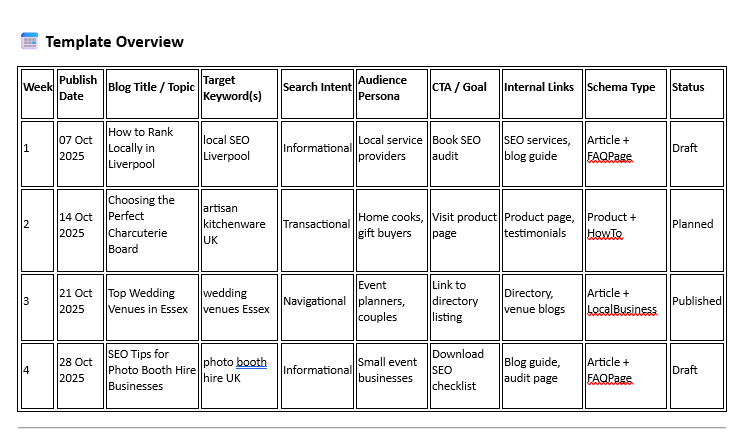
SEO Content Calendar Template
Plan your blog strategy like a detective—methodically, insightfully, and with ranking in mind.
🧠 Column Breakdown
- Week / Date: Helps clients stay consistent and plan ahead
- Blog Title / Topic: Should include keyword naturally and reflect user intent
- Target Keyword(s): Use long-tail, GEO-modified phrases
- Search Intent: Informational, Transactional, Navigational
- Audience Persona: Who the blog is written for—be specific
- CTA / Goal: What action should the reader take? (e.g., book, buy, share)
- Internal Links: Pages or blogs to link to for SEO and UX
- Schema Type: Recommended structured data for AI visibility
- Status: Draft, Planned, Published, Needs Review
🎯 Strategic Tips for Using the Calendar
- Plan 3 months ahead to stay proactive with seasonal trends
- Mix evergreen and timely content for long-term traffic and short-term engagement
- Use AI prompt testing to validate visibility before publishing
- Update older posts quarterly to maintain freshness and rankings
- Track performance using Google Search Console and AI surfacing tools
🧠 Detective’s Insight
“A content calendar isn’t just a schedule—it’s a strategy map. Every blog should serve a purpose, answer a question, and lead your audience closer to action.”
🕵️♂️ Ready to stop guessing and start ranking?
Whether you’re a local business, creative entrepreneur, or niche service provider, your content deserves to be seen. Let The Business Detective help you uncover the strategy behind visibility.
🔍 Book a free blog audit or start building your 90-day content strategy today.
Your audience is searching. Let’s make sure they find you.