How to Use Google Search Console and Google Analytics Together to Make Better SEO Decisions
If you run a business website, you may already have Google Search Console and Google Analytics installed.
But having the tools and actually using the information they provide are two very different things.
At The Business Detective, Google Search Console and Google Analytics are two of the main tools we use when investigating website and SEO performance.
And increasingly, we’re adding another layer to that analysis:
AI search visibility.
Search is changing. Customers can discover a business through traditional Google results, social media, AI-generated search experiences and platforms such as Microsoft Copilot.
That makes understanding your data more important than ever.
The good news is that you don’t need to spend hours looking at complicated dashboards.
You simply need to know which questions to ask of the data.
In this guide, I’ll explain how Google Search Console and Google Analytics work together, what I look for when reviewing a website and how we’re beginning to incorporate AI search data into our client reporting.
I’ll also show you some real-world results from one of our clients, Aviation & Binoculars, to demonstrate why looking beyond headline traffic numbers can uncover much more useful opportunities.
Google Search Console vs Google Analytics: What’s the Difference?
Let’s start with one of the most common areas of confusion.
Google Search Console and Google Analytics don’t do the same job.
A simple way of thinking about them is:
Google Search Console helps us understand what happens before someone reaches your website from Google Search.
Google Analytics helps us understand what happens once people arrive.
Google Search Console can tell us:
How many times your website appeared in Google Search.
How many people clicked.
Which searches triggered your website.
Which pages appeared.
Average search positions.
Click-through rates.
Whether Google can successfully crawl and index your pages.
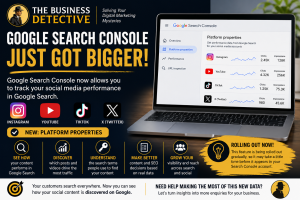
- Capture Social media data
Google Analytics can then help us investigate:
How many people visited.
Where visitors came from.
Which pages they viewed.
How engaged they were.
Which channels generated traffic.
Which actions visitors completed.
Whether website visits contributed towards enquiries or sales.
Put those two sets of information together and we can begin following a customer’s journey from search to website visit to commercial outcome.
A Real Example: When More Google Visibility Doesn’t Mean More Clicks
This is where analysing the numbers becomes useful.
During July 2026, one of our SEO clients, Aviation & Binoculars, recorded:
12,280 Google organic impressions
and:
240 Google organic clicks
At first glance those are simply two numbers.
But compare them with June and something interesting appears.
Google impressions increased from 10,981 to 12,280.
That’s an increase of approximately 11.8%.
Google was therefore showing the website more frequently.
That’s positive.
However, clicks moved in the opposite direction:
June: 256 clicks
July: 240 clicks
So what does that tell us?
It doesn’t mean SEO suddenly stopped working.
Quite the opposite: visibility had increased.
Instead, it gives us a question to investigate:
Why aren’t those additional search appearances generating more website visits?
That leads to practical SEO actions.
We can investigate:
Which queries gained impressions.
Which pages appeared more frequently.
Their average positions.
Their click-through rates.
Whether page titles could be stronger.
Whether meta descriptions better match search intent.
Whether some queries are appearing at positions where clicks remain naturally low.
This is why I don’t recommend judging SEO using a single metric.
If we’d only looked at impressions, we’d have said performance improved.
If we’d only looked at clicks, we’d have said performance declined.
Looking at both tells us something far more useful:
Google visibility increased, but converting that visibility into clicks became the next opportunity.
That’s what good SEO reporting should do.
It should tell you what to do next.
How to Review Your Own Search Console Data
You can carry out the same investigation on your website.
Open Google Search Console and go to Performance.
I normally start by comparing:
Last 28 days vs previous 28 days
or:
This month vs previous month.
Start with four metrics:
Total Impressions
How frequently is Google displaying your website?
Increasing impressions can indicate that Google is beginning to associate your website with a broader range of relevant searches.
Total Clicks
How many people actually visit?
Visibility is useful, but ultimately we want people reaching the website.
Click-Through Rate
CTR tells us what percentage of impressions result in clicks.
A page receiving thousands of impressions but relatively few clicks deserves investigation.
Average Position
This provides useful context around where your pages are appearing.
But don’t become obsessed with a single average ranking.
Instead, use it to identify opportunities.
Find Pages That Are Nearly Winning
One of my favourite SEO opportunities is finding pages sitting just outside stronger page-one positions.
Again, our Aviation & Binoculars data provides a good example.
During July:
Aviation Furniture UK improved to approximately position 8.
WW2 Binoculars improved from approximately position 11.7 to 10.8.
Big Eye Binoculars improved across clicks, CTR and average ranking.
Man Cave Furniture strengthened into page-one territory.
Meanwhile, Jet Engine Tables increased from 3 to 10 Google clicks.
These are exactly the pages I want to investigate.
Why?
Because moving a relevant page from position 40 to 35 might make little immediate commercial difference.
Moving a strong commercial page from position 11 to position 7 potentially can.
So rather than spreading SEO time across an entire website, we can concentrate on pages already demonstrating momentum.
Actions might include:
Improving the content.
Strengthening internal links.
Answering additional customer questions.
Improving titles and descriptions.
Adding original photographs.
Adding relevant expertise.
Strengthening calls to action.
This is a much more focused use of a small business’s SEO budget.
Now Move Into Google Analytics
Search Console has told us how the website performs in Google.
Now we need to investigate what visitors actually do.
This is where Google Analytics becomes particularly valuable.
Start by looking at your traffic acquisition.
You may see channels including:
Organic Search
Direct
Organic Social
Referral
Paid Search
and increasingly other forms of digital discovery.
The question isn’t simply:
“How much traffic did we get?”
Instead ask:
“Which traffic actually did something useful?”
Look at Your Landing Pages
Your landing pages tell you where people begin their website journey.
Imagine Search Console shows that a particular service page has gained significantly more Google clicks.
That’s good.
Now Analytics can help us investigate what happened next.
Did visitors:
Engage with the page?
Continue to another page?
View products?
Visit the contact page?
Complete an enquiry?
Purchase something?
This can uncover a completely different problem.
For example:
Page A
500 impressions → 50 clicks → strong engagement → enquiries
Page B
2,000 impressions → 100 clicks → poor engagement → no enquiries
Page B doesn’t necessarily need more SEO traffic.
It may need a better website experience.
Perhaps the content doesn’t answer the searcher’s question.
Perhaps there isn’t enough evidence of expertise.
Perhaps the call to action isn’t obvious.
Perhaps the page doesn’t work particularly well on mobile.
Analytics helps us move beyond getting people to the website and towards getting the website to work harder once they arrive.
Connect SEO to Sales and Enquiries
This is the most important stage.
Businesses don’t ultimately pay for impressions.
They want outcomes.
During July, Aviation & Binoculars recorded sales including:
A Firestreak Missile
A Francis Spotlight
TZK 10×80 Binoculars
That’s important context.
Search visibility wasn’t simply generating impressive-looking charts.
The website was continuing to generate commercial outcomes.
However, this is also where responsible reporting matters.
For example, Firestreak-related content was already gaining AI search visibility.
A Firestreak Missile was subsequently sold.
That’s interesting.
But without appropriate attribution data, we cannot claim AI search caused that sale.
What we can say is:
The product/topic was gaining search visibility and a commercial sale occurred during the same period.
That’s a positive signal worth monitoring.
Over time, better Analytics configuration and ecommerce/conversion tracking can help us understand these relationships much more accurately.
The New Layer: AI Search Data
This is where SEO reporting is becoming particularly interesting.
Traditional reporting has largely concentrated on:
Rankings → Impressions → Clicks → Traffic → Conversions
But customers increasingly have another way to discover businesses.
AI-generated search.
Google is incorporating generative AI into its search experiences, while Microsoft has introduced AI-powered search and Copilot experiences.
And we’re now beginning to receive data showing whether websites are appearing within them.
What We Found in Google Search Console
During July, Aviation & Binoculars recorded approximately:
2,116 Google Generative AI impressions.
Even more interesting was the content Google surfaced.
Pages receiving AI visibility included:
German WW2 MP44-related products.
How to Identify Authentic WWII Binoculars.
Aircraft & Ejection Seats.
RAF Vulcan Bomber Ejection Seat.
Big Eye Binoculars.
Jet Engine Tables.
WW2 Binoculars.
One page particularly stood out:
How to Identify Authentic WWII Binoculars.
Why?
Because this isn’t simply a product listing.
It’s specialist educational content.
It uses the business owner’s genuine knowledge to help collectors understand and identify historical binoculars.
That gives us an important content marketing clue.
Specialist Knowledge Is Becoming Even More Valuable
AI search creates another reason for businesses to produce genuinely useful content.
For a specialist business such as Aviation & Binoculars, that could include:
Historical information.
Identification guides.
Manufacturer information.
Military markings.
Provenance.
Restoration advice.
Collector guides.
Original photographs.
First-hand knowledge.
The aim isn’t to churn out hundreds of generic AI-written articles.
It’s almost the opposite.
The opportunity is to publish information that demonstrates real expertise and experience that isn’t available everywhere else.
Our July data suggests this type of specialist content can perform across both traditional and AI-powered search.
Bing Gives Us Another AI Measurement
We also use Bing Webmaster Tools.
During July, Aviation & Binoculars recorded:
3,551 Bing organic impressions
53 Bing organic clicks
and:
55 Bing AI citations
Those AI citations appeared across 13 different days during the month.
This provides another useful signal that the website’s content is being discovered and referenced within AI-powered search experiences.
It’s important not to add Google’s Generative AI impressions and Bing’s AI citations together.
They measure different things.
But viewed alongside one another, they provide independent evidence that the website is developing visibility beyond traditional search results.
That’s a significant change in SEO reporting.
The Modern Search Journey Is Getting More Complicated
Previously we might have imagined a customer journey like this:
Google → Website → Enquiry
Today it could look more like:
Instagram → Google → AI answer → Website → Direct return visit → Purchase
Or:
AI assistant → Brand discovery → Google search → Product page → Purchase
That makes perfect attribution increasingly difficult.
But it also makes tools such as Search Console, Analytics and Bing Webmaster Tools increasingly valuable.
Each provides another piece of evidence.
Our job is to put those pieces together.
My Recommended Monthly Website Investigation
If you’re a small business owner, you don’t need a 50-page SEO report.
Start by answering these questions every month:
Search Visibility
Are Google impressions increasing?
Are clicks increasing?
Which queries are growing?
Which pages are gaining visibility?
Which pages sit around positions 5–15?
Click Opportunity
Which pages receive lots of impressions but relatively few clicks?
Can titles or descriptions be improved?
Does the search intent match the page?
Website Behaviour
Which landing pages receive organic visitors?
Do people engage?
Which pages encourage further website exploration?
Commercial Performance
Are people:
Calling?
Completing forms?
Requesting quotations?
Making purchases?
Booking services?
AI Search
Is the website beginning to appear in Google’s Generative AI reporting?
Is Bing citing the website?
Which topics and pages appear most frequently?
Are particular types of specialist content performing particularly well?
Then ask one final question:
What Are the Three Most Valuable Things We Should Do Next?
For Aviation & Binoculars, our analysis produced three clear priorities.
1. Improve pages already close to stronger Google rankings
Concentrate effort around WW2 Binoculars, Aviation Furniture, Ejection Seats, Jet Engine Tables and Big Eye Binoculars.
2. Improve click-through rates
Google visibility has increased, but we want those additional impressions turning into more website visits.
3. Strengthen AI search visibility
Build upon the topics that Google and Bing already appear to recognise, particularly WWII binoculars, aviation artefacts, ejection seats and military collectables.
That’s a useful SEO report.
Not simply:
“You had 12,280 impressions.”
But:
“Here’s what the data tells us, here’s where the commercial opportunity lies, and here’s what we’re going to do next.”
Final Thoughts
Google Search Console and Google Analytics are incredibly powerful free tools.
But the numbers themselves don’t improve your website.
What you do with them does.
Search Console helps us understand how a business is being discovered.
Analytics helps us understand what visitors do afterwards.
Conversion and sales data help us understand whether that activity is contributing towards business growth.
And now AI search reporting is adding another layer:
Is your business becoming part of the answers generated by AI?
Our Aviation & Binoculars results provide a good example.
During one month the website generated:
12,280 Google organic impressions
240 Google organic clicks
2,116 Google Generative AI impressions
3,551 Bing organic impressions
53 Bing organic clicks
55 Bing AI citations
alongside sales of several specialist products.
Those numbers aren’t the end of the investigation.
They’re the beginning.
They help us decide where to optimise, what content to create, which pages deserve attention and where the next commercial opportunity may lie.
At The Business Detective, that’s how we believe SEO reporting should work.
No jargon for the sake of it.
No enormous reports filled with numbers nobody uses.
Just three questions:
What’s working?
Where’s the opportunity?
What should we do next?
Because collecting more data isn’t the objective.
Turning that data into better business decisions is. Contact us today for more information on how The Business Detective can help.