Navigating a new SEO Landscape
The Great Search Shift: Navigating a New SEO Landscape After Google’s Search Results Change
In a significant, yet quietly implemented, shift, Google has recently altered the way it presents search results, discontinuing the practice of identifying and ranking the top 100 results and instead restricting the visible output to just the top 10.
While this change may seem subtle to the average user, who rarely ventures beyond the first page of results, it has sent shockwaves through the search engine optimisation (SEO) community. This alteration is more than just a minor tweak; it represents a fundamental recalibration of how businesses, SEO agencies, and marketers track performance and measure success.
The old method, which allowed users and, more critically, third-party SEO tools to retrieve up to 100 results per query by using the “&num=100” parameter in the URL, was a cornerstone of modern SEO.
Rank-tracking software relied on this function to efficiently scrape data, providing a comprehensive view of a website’s ranking for a vast number of keywords. SEO professionals could quickly and cost-effectively monitor their clients’ positions, identify a range of ranking opportunities, and track the impact of their strategies well beyond the coveted first page. Now, that is all gone.
The digital landscape has been profoundly altered, forcing a complete re-evaluation of how businesses approach their online visibility.
The Seismic Impact on SEO Companies and the Industry
The immediate fallout of this change has been a disruption of the entire SEO ecosystem. The tools that once provided a robust, data-rich view of the search landscape have been rendered less effective, if not obsolete in their previous form.
Rank trackers, which once pulled 100 results in a single, efficient request, must now make ten separate requests to gather the same amount of data, a process that is not only less efficient but also exponentially more expensive.
This has led to a cascade of problems for SEO agencies and their clients:
1. Data Gaps and Inflated Costs: Many SEO platforms have seen significant disruptions in their data, with missing rankings and inconsistent reporting. The cost of data retrieval has skyrocketed, as the per-query expense for many API services is now tenfold what it was previously. This increase in operational costs is a serious concern for agencies, who must either absorb the extra expense, pass it on to clients, or fundamentally change their pricing models.
2. A New Standard for “Success”: For years, SEO strategies were often built around the goal of achieving a top 10 ranking. However, a significant part of the strategy also involved getting a page to rank on the first, second, or third page, and then working to improve its position. The new reality makes it much more difficult to track this progress. A page that previously ranked at position 15 might now be completely invisible in standard tool reports, making it a challenge to demonstrate the value of ongoing SEO work. This raises a crucial question: how do you prove progress when the very data used to track it has become so difficult to obtain?
3. Shifting Focus from “Rank” to “Presence”: The old system fostered a certain obsession with raw ranking numbers. SEO professionals would meticulously track a site’s position for thousands of keywords, often reporting on the movement of a page from #23 to #18 as a victory. While this data was useful, it could also be a distraction. The new paradigm forces a much-needed shift away from a simple “rank-chasing” mentality to a more holistic view of “online presence” and “visibility.”
The focus must now be on what truly matters: traffic, engagement, and conversions.
A New Mandate for Businesses: Adapting to the Change
In this new environment, businesses can no longer rely on a simple keyword report from a third-party tool to tell the whole story of their online performance.
The onus is on them to become more sophisticated in their understanding and use of the data available to them.
To effectively navigate this shift, businesses must embrace a more comprehensive approach to digital analytics, with a particular emphasis on first-party data and the invaluable tools provided directly by Google.
1. Go Deeper with Google Search Console:
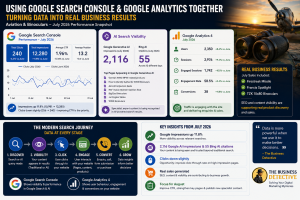
Google Search Console (GSC) has always been an indispensable tool for SEOs, but its importance has now reached a new level. Unlike third-party tools that rely on scraping public search results, GSC provides a direct feed of data on how your site is performing in Google Search. Businesses should be using GSC more thoroughly than ever before to:
- Track Impressions and Clicks: The Performance report in GSC is the new gold standard for understanding your search presence. It shows the exact keywords people used to find your site, the number of times your pages appeared in search results (impressions), and the number of clicks they received. This data is not limited to the top 10; it shows every query where your site appeared, regardless of its position.
- Identify Ranking Pages: GSC allows you to see the average position for a given query, providing a more accurate (and directly sourced) understanding of where you rank. While it doesn’t offer the real-time, on-demand tracking of a rank tracker, it provides the most truthful data available.
- Monitor Technical Health: GSC’s tools for Index Coverage, Core Web Vitals, and Mobile Usability are critical for ensuring your site is healthy and properly indexed by Google. These technical factors are more important than ever, as they are a prerequisite for ranking at all.
2. Maximise the Potential of Google Analytics:
While GSC provides “pre-click” data (what happens on the search results page), Google Analytics (GA) provides the essential “post-click” data (what happens on your website). The two tools are a powerful combination, and businesses should be using them in tandem to build a complete picture of their online visibility. Key uses for Google Analytics now include:
- Analysing Organic Traffic: GA allows you to see how many people are coming to your site from organic search. You can segment this traffic to understand which pages, and even which specific content, is driving the most visitors.
- Understanding User Behaviour: Beyond just traffic numbers, GA provides insights into user behaviour. You can see how long visitors from organic search stay on your site, which pages they visit, and whether they are completing key actions, such as making a purchase, filling out a form, or signing up for a newsletter. This is the ultimate measure of success and a clear indication of whether your SEO efforts are generating meaningful business results.
- Connecting GSC and GA Data: By linking your GSC and GA accounts, you can view GSC data directly within your GA reports. This integration allows for powerful analysis, helping you to connect a specific keyword’s performance in search (GSC data) to the on-site behavior of visitors who clicked on it (GA data).
The Path Forward: A Call for a Smarter SEO
Google’s recent change, while disruptive, can be seen as a forcing function for a more mature and data-driven approach to online marketing. The days of simply buying a tool to track your rank and getting a quick, easy report are over.
The new reality demands a more hands-on, strategic, and analytical approach.
For businesses, this means investing time and resources into a deeper understanding of their own data. It means moving beyond a reliance on simple vanity metrics and focusing on the true drivers of growth: traffic, engagement, and conversions.
For SEO companies, it’s an opportunity to showcase their true value as strategic partners, not just rank-tracking technicians. The focus must shift to providing comprehensive analysis, identifying the real business impact of their work, and demonstrating a command of the digital ecosystem that extends far beyond a single, now-defunct parameter.
In the end, this change is not a setback, but a challenge. It’s an invitation to get smarter about how we measure success online.
By embracing the power of Google Search Console and Google Analytics, businesses can not only survive this new shift but thrive in a more transparent, performance-focused, and ultimately more rewarding, digital landscape.
The “Why” Behind the Change (A Deeper Dive)
This isn’t just a random shift; it’s part of a larger strategy.
User Experience (UX): Google’s primary goal is to provide the best possible experience for the user. Data has long shown that an overwhelming majority of users never click past the first page of search results. Displaying 100 results might be seen as unnecessary clutter and a waste of resources for a tiny minority of “power users.”
AI and Machine Learning: With the rise of AI Overviews, conversational search, and other generative AI features, the traditional “10 blue links” format is evolving. Google is likely streamlining the process to focus on delivering more direct, “answer-based” results rather than just lists of links. The &num=100 parameter might have been a legacy feature that didn’t align with this new, more efficient, and resource-intensive model.
Combating Automated Scraping: This is a crucial, often-overlooked point. The &num=100 parameter was and is heavily abused by bots and automated scrapers.
By removing it, Google makes it exponentially harder and more expensive for third parties to scrape vast amounts of data, thereby reducing server load, improving efficiency, and potentially protecting their proprietary data.
This action is a clear signal that Google is taking a more aggressive stance against large-scale, automated data collection.
2. Practical, Actionable Advice for Businesses (More “How-To”)
Using Google Search Console:
* Navigate to the “Performance” report.
* Set the date range (e.g., last 28 days).
* Sort the data by “Average Position” and filter to show positions between 11 and 20.
This will reveal the exact queries and pages that are just off the first page, giving you a clear list of optimisation targets.
Beyond GSC and GA: SEMRush is a great example of a Tool that focuses on other metrics and not just traditional rank tracking.
“Share of Voice” Metrics: Businesses should now focus on “Share of Voice” or “Visibility Share” in their key markets. This metric, often provided by more sophisticated SEO platforms, tracks how much of the organic traffic for a set of keywords a site captures relative to its competitors. It’s a more holistic measure of success than a single ranking number.
Traffic by Page/Content: The importance of analysing organic traffic at the content level cannot be understated. What specific blog posts or product pages are driving the most organic visitors? This tells you what’s working and where to invest more resources.
Brand vs. Non-Brand Traffic: Businesses should segment their traffic in GA to understand the proportion of branded (e.g., “Company X shoes”) vs. non-branded (e.g., “best running shoes”) traffic. A healthy increase in non-branded traffic is a powerful indicator of successful SEO, independent of any specific ranking number.
The Future of SEO: A Forward-Looking Perspective
So what will SEO look like in future years…
The Rise of “GEO” (Generative Engine Optimisation): Introduce the concept of “GEO,” which is about optimising content for AI-driven search platforms and chatbots.
Focus on E-E-A-T: Google’s E-E-A-T (Experience, Expertise, Authoritativeness, and Trustworthiness) guidelines. In a world with less visible ranking data, signals of quality and credibility will be more important than ever.
Google is rewarding sites that are clearly run by real people with real expertise.
Paid Search Integration: With organic data becoming more complex, the synergy between paid search (PPC) and organic SEO is more important than ever. Paid ads can now be used more strategically to fill the visibility gaps left by a lack of deep organic ranking data.
If you are interested in The Business Detective services then do not hesitate to Contact us to discuss you project or business.